What are a Transport Manager’s legal responsibilities?
Being qualified is only the starting point. The role itself requires operational competence and active control, not passive association with the licence.
That usually means active oversight of:
- Drivers’ hours compliance and infringements
- Tachograph systems and reporting
- Vehicle maintenance arrangements and PMI evidence
- Defect reporting and rectification
- Operator licence undertakings and management controls
What catches new TMs out
The CPC proves knowledge. It does not prove that you can apply that knowledge in a live operation where records are messy, responsibilities are blurred, and commercial pressure is constant.
That gap between passing an exam and demonstrating true operational competence is where many newly qualified Transport Managers first feel the pressure.
What does “continuous and effective management” actually mean?
This is the legal benchmark applied to the role. It means active, ongoing oversight of transport compliance rather than occasional involvement or relying on others to “keep an eye on things”.
In practice, it means:
- You review infringement reports and act on them
- You challenge maintenance providers when standards slip
- You intervene when compliance gaps appear
- You keep a documented trail of oversight and corrective action
- You monitor licence undertakings consistently, not occasionally
What that looks like on paper
Your involvement should be visible in the records: comments, actions, debriefs, follow-up, and evidence that issues were not simply left to drift.
A named TM who cannot show their footprint in the systems is vulnerable very quickly once scrutiny starts.
What is good repute — and how can it be lost?
Good repute is not a nice extra. It is fundamental to acting as a Transport Manager. If it is lost, the role itself becomes unavailable while disqualification remains in force.
Good repute is about whether you:
- Demonstrate honesty and integrity
- Exercise real and ongoing operational control
- Maintain compliant, auditable systems
- Avoid serious or repeated compliance failures
What losing it can mean
- Removal from the operator’s licence
- Disqualification from acting as a Transport Manager
- A fixed or indefinite period out of the role
- Possible training or re-examination conditions before return
That is where the real power of the Traffic Commissioner starts to bite. A Traffic Commissioner does not strike directors off through Companies House, but licensing powers can make continued involvement in licensed transport very difficult or impossible where repute, competence, or control standards are not met.
Passing the CPC gives you the qualification. Operational competence and good repute are what keep that qualification professionally usable.
What happens if the Transport Manager is also a director?
This is where exposure increases. If you are both a director and the named TM, failures in transport control can spill into wider questions about governance, operator fitness, and whether the business is still meeting the standards expected of a Standard licence holder.
Why it matters
You are no longer just managing compliance in one narrow role. You are linking management control, business oversight, and licensing risk in the same person.
In plain English
You are not just lending your qualification to the business. You are lending your judgement, your control, and your professional standing.
For directors who need a clearer understanding of board-level accountability, our Operator Licence Awareness Training (OLAT) is often the more appropriate course.
Case Study: The Cost of Failing Under Operational Pressure
To understand how quickly things can go wrong when a Transport Manager lacks operational resilience under pressure, we only need to look at the official Traffic Commissioner decision involving DR Freight Ltd.
The company was granted a licence on the strict condition that they commissioned an independent compliance audit. However, the operational reality was a disaster. Vehicle safety inspections (PMIs) were delayed by up to six months, brake tests were ignored, and drivers were not reporting defects.
The Fatal Mistake: Faking the Audit
Faced with a deadline for the compliance audit and knowing the systems were failing, the Transport Manager panicked. Instead of fixing the issues, he used an audit provider's letterhead to fraudulently manufacture a fake audit report and submitted it to the Traffic Commissioner.
The Consequence for the TM
The Traffic Commissioner called it a "breathtaking act of dishonesty". The Transport Manager lost his good repute and was disqualified indefinitely from acting as a TM anywhere in the UK.
The Consequence for the Director
The Director claimed ignorance of the fake audit. The TC rejected this defence, stating the Director is ultimately responsible for the licence undertakings. The Operator Licence was revoked, and the Director was disqualified for two years.
The Lesson: Book smarts do not equal operational competence. If you don't know how to handle failing systems or upcoming audits, you need practical role readiness training before you resort to desperate, career-ending measures.
The commercial reality: compliance does not have to be expensive
Compliance is often talked about as a cost. In reality, unmanaged risk is what becomes expensive.
Well-managed systems help prevent:
- Roadside prohibitions
- Recovery and disruption costs
- Escalating OCRS exposure
- Missed work and contract penalties
- Audits that expose long-running weaknesses
The wider point
Well-managed compliance is not anti-commercial. It is cost control. It protects margins, operating authority, and professional reputation.
The first 90 days as a newly qualified Transport Manager
Newly appointed TMs often feel pressure to make immediate changes. That instinct is understandable, but your first job is usually to understand what you have inherited before you start redesigning it.
Focus your first 90 days on:
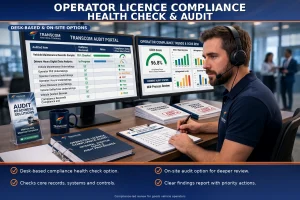
- Conducting a comprehensive O-Licence compliance check to see if legal undertakings are actually being met.
- Reviewing maintenance records, PMIs, brake evidence and recurring defects.
- Understanding who does what day to day and where reporting really sits.
- Assessing tachograph analysis quality, frequency, and follow-up action.
- Confirming that your appointment and role are properly formalised on the licence.
TM Interview Preparation
If you are newly added to a licence—or applying for a new licence entirely—the Office of the Traffic Commissioner may call you in for a competence interview. You cannot rely on textbook theory here. TM interview preparation requires you to know your specific compliance figures, PMI intervals, and defect reporting processes inside out.
The legacy handover trap: is your internal training already outdated?
One of the biggest risks for a newly qualified TM is inheriting a system that feels familiar but is already weak. Internal handover can be useful. It can also be the point where stale habits get passed on as if they are current standards.
Ask yourself:
- When did the outgoing TM last refresh formally?
- Are you being taught what is compliant, or just what has become habit?
- Would the systems you have inherited stand up to an unannounced DVSA audit?
The danger
“I was shown to do it this way” is not a defence. Once you are the named TM, responsibility for verifying whether those systems are actually good enough sits with you.
Many newly qualified TMs seek help from "consultants" or book cheap top-up courses through training agencies. If you want to protect your new qualification, read our guide on National Compliance Training Brokers vs Specialists to ensure you are getting legally sound, expert instruction.
Bridging the gap between qualification and operational reality
The CPC teaches law, structure, and principle. The role itself requires applied judgement under pressure. That is exactly why the next stage matters.
Transport Manager Role Readiness Programme
A 2-day live, tutor-led practical workshop for newly qualified Transport Managers. It is designed specifically to bridge the gap between passing the CPC and taking responsibility on a live operator’s licence.
- Scenario-led: Practical decision-making, not just theory.
- Operational Competence: Learn exactly what to do when compliance pressure becomes real.
- O-Licence Compliance Check: Learn how to audit a business before you sign your name to it.
- Role-readiness: Helps move from "qualified on paper" to "credible in practice".
Use the Role Readiness Programme to build operational judgement before compliance pressure exposes weak systems.
Other sensible next steps
- Transport Manager 2 Day Refresher Course for current CPD and practical updating
- OLAT for directors and responsible people who need stronger operator licence understanding
- Read our realistic guide on Transport Manager CPC Difficulty
“The interactive nature of Gareth’s presentation style is undoubtedly the reason I would recommend this Transport Manager course. A good value course delivered with accuracy and confidence.”
Frequently asked questions for newly qualified Transport Managers
What does a newly qualified Transport Manager need to do first?
Make sure your appointment is correctly formalised on the licence, then conduct a full O-Licence compliance check. Review maintenance records, PMI intervals, tachograph systems, drivers’ hours controls, and defect reporting before you start making major changes.
What is continuous and effective management in transport?
It is the legal benchmark applied to the role. It means active, ongoing oversight of transport compliance and operational competence, rather than passive or occasional involvement.
What happens in a Traffic Commissioner TM interview?
If you are added to a new licence, the TC may call you in to assess your operational competence. TM interview preparation is vital—you will be expected to know the specific compliance KPIs of the fleet you are taking over, not just the CPC syllabus.
Can a Transport Manager lose their good repute?
Yes. As seen in the DR Freight case, if good repute is lost due to a lack of operational competence or honesty, the person can be disqualified from acting as a Transport Manager while that disqualification remains in force.
Can a Traffic Commissioner stop a director from running a transport company?
The commissioner does not strike directors off through Companies House, but licensing and disqualification powers can make continued involvement in licensed transport commercially or legally impossible.
Does compliance always increase operating costs?
No. Good compliance often reduces long-term cost by preventing prohibitions, disruption, repeated infringements, poor OCRS exposure, and avoidable escalation.
What happens at a Public Inquiry?
A Public Inquiry is a formal hearing before a Traffic Commissioner examining licensing and compliance concerns. Records, systems, operational competence, and credibility are all highly relevant.
Do newly qualified Transport Managers need further training?
Often, yes. Passing the CPC proves legal knowledge. It does not prove day-to-day operational judgement. Practical post-qualification support (like a Role Readiness programme) can help bridge that gap.
What is the difference between a Transport Manager and an operator director?
The Transport Manager is responsible for continuous and effective management of transport activities. The director has wider governance and operator responsibility. On a Standard licence, weakness in either role can create licence risk.
Operate with clarity. Lead with accountability.
Passing the CPC gets you through the qualification stage. The next challenge is achieving true Transport Manager role readiness—learning how to apply that knowledge under operational pressure, where poor systems, weak evidence and commercial demands can quickly expose inexperience.
That is exactly why the Transport Manager Role Readiness Programme exists. It is there to help newly qualified Transport Managers move from qualified on paper to credible in practice — before responsibility carries avoidable consequences.